Quickstart#
Obtaining statistics#
In order to obtain statistics from coalescent distributions, we first need to define such a distribution. This is done by creating a Coalescent object which serves as an entry point from which all statistics can be obtained. Below is an example of a simple Kingman coalescent distribution with n=10 lineages, and a single population of constant size 1.
library(phasegen)

pg <- load_phasegen()
coal <- pg$Coalescent(
    n = 10,
    demography = pg$Demography(
        pop_sizes = 1
    )
)
We can now access various statistics from this distribution which are made available as cached properties of the component distribution of the Coalescent object:
# mean coalescence time or tree height
coal$tree_height$mean
# variance of the coalescence time
coal$tree_height$var
# expected total branch length
coal$total_branch_length$mean
# expected site-frequency spectrum
barplot(coal$sfs$mean$data, main = "SFS")
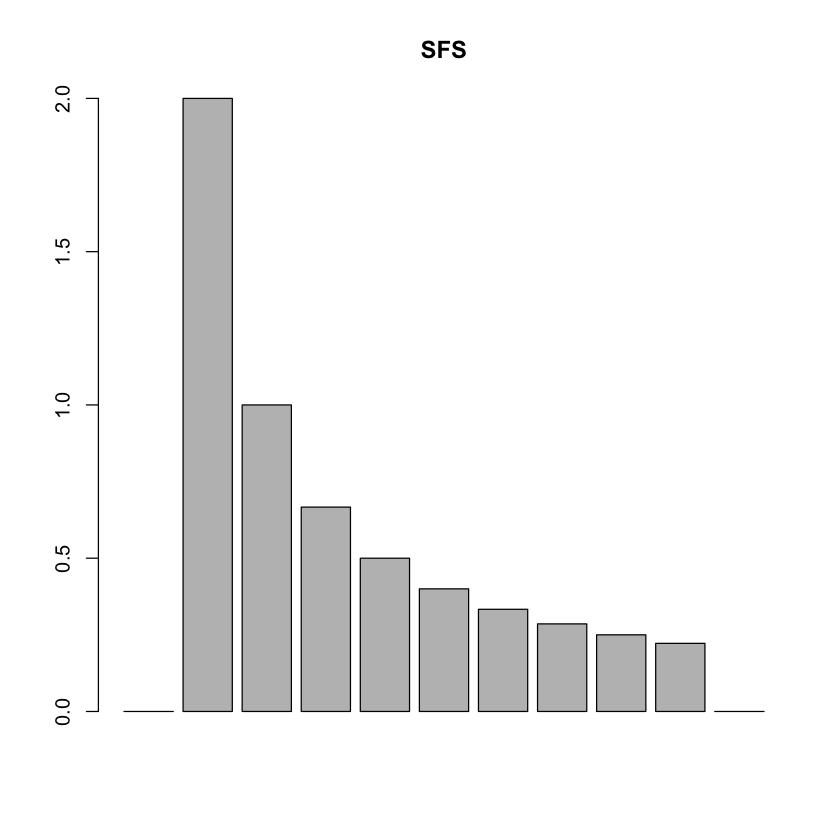
In fact, coal.tree_height, coal.total_branch_length, and coal.sfs are all PhaseTypeDistribution objects which can be accessed to obtain statistics on these distributions. If you would like to take a closer look at the API reference, these are TreeHeightDistribution, PhaseTypeDistribution, and UnfoldedSFSDistribution, respectively. PhaseTypeDistribution instances support the computation of moments and cross-moments of arbitrary order, which is only limited by the computational burden associated with higher-order moments. TreeHeightDistribution extends PhaseTypeDistribution and offers additional information through the PDF, CDF and quantile function.
coal$tree_height$quantile(0.95)
x <- seq(0, 4, length.out = 100)

plot(x, coal$tree_height$pdf(x), type = "l", main = "PDF")

Before we discuss on how to obtain more complex statistics, let us first define a more complex coalescent distribution. Here, we define a two-population coalescent using the BetaCoalescent model, where the population sizes and migration rates are time-dependent. This is done by specifying a Demography object, which is configured with a series of DemographicEvent objects.
coal <- pg$Coalescent(
    n = pg$LineageConfig(list(pop_0 = 3, pop_1 = 5)),
    model = pg$BetaCoalescent(alpha = 1.7),
    demography = pg$Demography(c(
        pg$PopSizeChange(pop = "pop_0", time = 0, size = 1),
        pg$PopSizeChange(pop = "pop_1", time = 0, size = 1.2),
        pg$PopSizeChange(pop = "pop_1", time = 5, size = 0.1),
        pg$PopSizeChange(pop = "pop_1", time = 5.5, size = 0.8),
        pg$MigrationRateChange(source = "pop_0", dest = "pop_1", time = 0, rate = 0.2),
        pg$MigrationRateChange(source = "pop_0", dest = "pop_1", time = 8, rate = 0.3),
        pg$MigrationRateChange(source = "pop_1", dest = "pop_0", time = 0, rate = 0.5)
    ))
)
We can iterate through the epochs of this demography. Within each Epoch, all rates are constant. pop_1 experiences a bottleneck at time 5, and that there is continuous migration between the two populations.
for (epoch in reticulate::iterate(coal$demography$epochs)) {
    print(epoch$to_string())
}
[1] "Epoch(start_time=0, end_time=5, pop_sizes=(pop_0=1, pop_1=1.2), migration_rates=(pop_0->pop_0=0, pop_0->pop_1=0.2, pop_1->pop_0=0.5, pop_1->pop_1=0)"
[1] "Epoch(start_time=5, end_time=5.5, pop_sizes=(pop_0=1, pop_1=0.1), migration_rates=(pop_0->pop_0=0, pop_0->pop_1=0.2, pop_1->pop_0=0.5, pop_1->pop_1=0)"
[1] "Epoch(start_time=5.5, end_time=8, pop_sizes=(pop_0=1, pop_1=0.8), migration_rates=(pop_0->pop_0=0, pop_0->pop_1=0.2, pop_1->pop_0=0.5, pop_1->pop_1=0)"
[1] "Epoch(start_time=8, end_time=inf, pop_sizes=(pop_0=1, pop_1=0.8), migration_rates=(pop_0->pop_0=0, pop_0->pop_1=0.3, pop_1->pop_0=0.5, pop_1->pop_1=0)"
Let’s take a look at the density of the underlying TreeHeightDistribution.
x <- seq(0, coal$tree_height$quantile(0.95), length.out = 100)

plot(x, coal$tree_height$pdf(x), type = "l", main = "PDF");

We can also compute higher-order moments of the SFS, such as the branch length correlation between branches subtending different numbers of lineages in the coalescent tree.
coal$sfs$corr$data
| 0 | 0.00000000 | 0.00000000 | 0.0000000 | 0.00000000 | 0.0000000 | 0.00000000 | 0.00000000 | 0 |
| 0 | 1.00000000 | -0.03204526 | -0.1390162 | -0.02137022 | -0.1400063 | -0.01838510 | 0.72560160 | 0 |
| 0 | -0.03204526 | 1.00000000 | -0.1370290 | -0.10913252 | -0.1264120 | 0.80364349 | -0.13043509 | 0 |
| 0 | -0.13901618 | -0.13702900 | 1.0000000 | -0.15851912 | 0.8517271 | -0.21133268 | -0.16912080 | 0 |
| 0 | -0.02137022 | -0.10913252 | -0.1585191 | 1.00000000 | -0.2324032 | -0.13282842 | -0.09281145 | 0 |
| 0 | -0.14000628 | -0.12641201 | 0.8517271 | -0.23240321 | 1.0000000 | -0.19100357 | -0.15794423 | 0 |
| 0 | -0.01838510 | 0.80364349 | -0.2113327 | -0.13282842 | -0.1910036 | 1.00000000 | -0.08907693 | 0 |
| 0 | 0.72560160 | -0.13043509 | -0.1691208 | -0.09281145 | -0.1579442 | -0.08907693 | 1.00000000 | 0 |
| 0 | 0.00000000 | 0.00000000 | 0.0000000 | 0.00000000 | 0.0000000 | 0.00000000 | 0.00000000 | 0 |
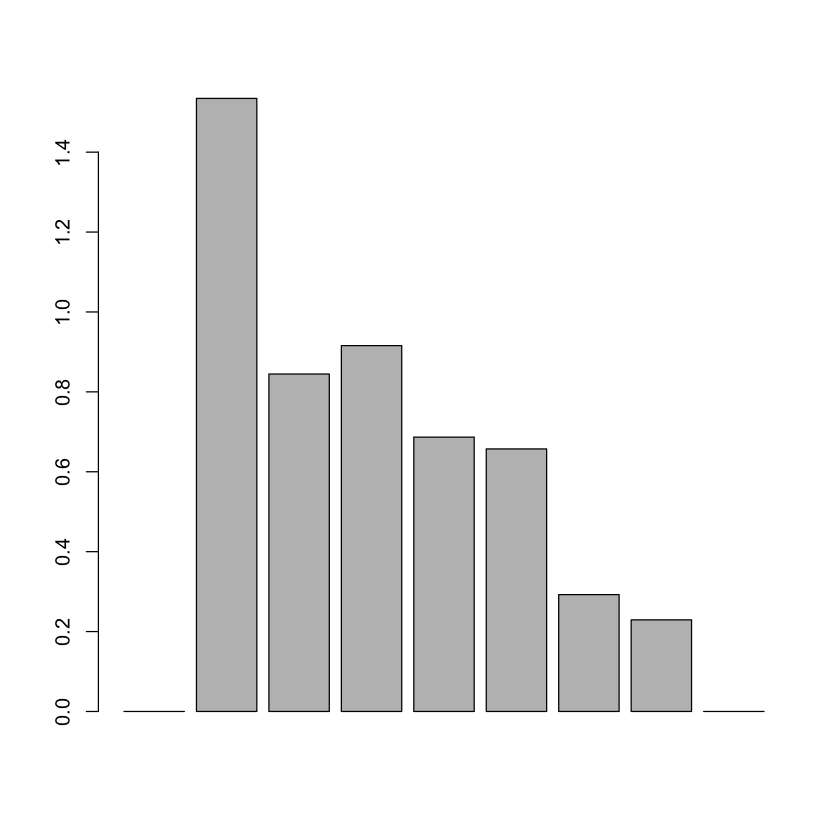
We may also marginalize over a single population. Here we obtain the mean SFS of pop_0, which represents the branch lengths for lineages that subtends i lineages in the coalescent tree, while spending time in population pop_0.
barplot(coal$sfs$demes$demes$pop_0$mean$data)
In the Using rewards section, you can read more about how to obtain more complex moments by means of specifying rewards.
Inferring parameters#
The availability of exact moments lends itself to gradient-based parameter estimation. This is commonly done based on the SFS, but higher-order moments are also thinkable, provided they can be computed from the data at hand. phasegen provides a lightweight framework for performing parameter inference which is done by defining an Inference object. Inference requires a parametrized coalescent distribution, a loss function, and parameter bounds to be specified. More specifically, the coal argument is a callable that returns a Coalescent object, based on the parameter values of the current optimization step, and loss is a callable specifying the current loss. By default, 10 independent optimization runs are performed using the L-BFGS-B algorithm, and the best result is returned.
Below we optimize a one-epoch demography with a single population size change where the time of change (t) as well as the resulting population size (Ne) are variable. The observed summary statistics is an SFS with a sample size of 10, and the loss function is the Poisson likelihood.
Warning
Parallelization across multiple cores does not work when using the R interface (hence parallelize = FALSE). This is due to problems when pickling in Python the R callback specified to Inference. Problems will also arise when using to_file() and from_file().
observation = pg$SFS(
    c(177130, 997, 441, 228, 156, 117, 114, 83, 105, 109, 652)
)

inf = pg$Inference(
    bounds = list(t = c(0, 4), Ne = c(0.1, 1)),
    coal = function(t, Ne) {
        return(pg$Coalescent(
            n = 10,
            demography = pg$Demography(c(
                pg$PopSizeChange(pop = 'pop_0', time = 0, size = 1),
                pg$PopSizeChange(pop = 'pop_0', time = t, size = Ne)
            ))
        ))
    },
    loss = function(coal, x) {
        return(pg$PoissonLikelihood()$compute(
            observed = observation$normalize()$polymorphic,
            modelled = coal$sfs$mean$normalize()$polymorphic
        ))
    },
    parallelize = FALSE
)
Upon construction, the inference object is ready to be optimized and the result can be obtained.
inf$run()
for (epoch in reticulate::iterate(inf$dist_inferred$demography$epochs)) {
    print(epoch$to_string())
}
[1] "Epoch(start_time=0, end_time=0.1455, pop_sizes=(pop_0=1)"
[1] "Epoch(start_time=0.1455, end_time=inf, pop_sizes=(pop_0=0.4814)"
We may also wish to perform parametric bootstrapping. In order to do this, we provide a callback function to resample the data, and set do_bootstrap = TRUE. Note that we specify observation to Inference, which is necessary for the resampling to work. Bootstrapping can be parallelized by running multiple optimization runs independently and adding params_inferred using add_bootstrap().
Note
Note that we explicitly generate random seeds for the resampling function. This is to avoid random number generation issues when running the code through reticulate.
inf = pg$Inference(
    bounds = list(t = c(0, 4), Ne = c(0.1, 1)),
    observation = pg$SFS(
        c(177130, 997, 441, 228, 156, 117, 114, 83, 105, 109, 652)
    ),
    coal = function(t, Ne) {
        return(pg$Coalescent(
            n = 10,
            demography = pg$Demography(c(
                pg$PopSizeChange(pop = 'pop_0', time = 0, size = 1),
                pg$PopSizeChange(pop = 'pop_0', time = t, size = Ne)
            ))
        ))
    },
    loss = function(coal, observation) {
        return(pg$PoissonLikelihood()$compute(
            observed = observation$normalize()$polymorphic,
            modelled = coal$sfs$mean$normalize()$polymorphic
        ))
    },
    resample = function(sfs, x) {
        return(sfs$resample(as.integer(sample(1:1e6, 1))))
    },
    do_bootstrap = TRUE,
    parallelize = FALSE
)
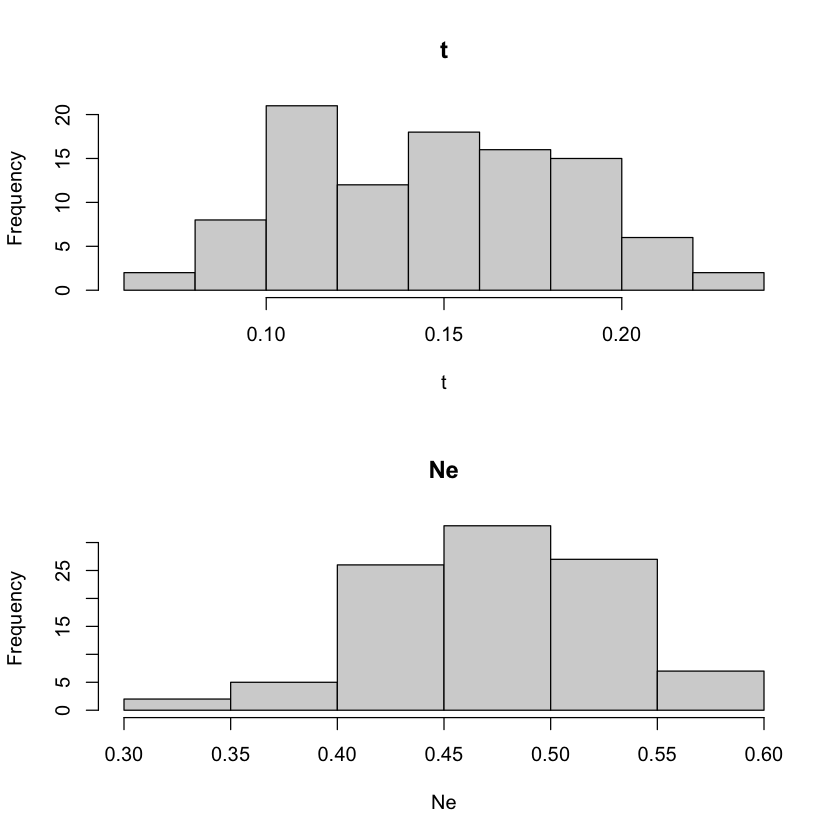
Let’s run the inference again and visualize the results.
inf$run()
par(mfrow = c(2, 1))
hist(inf$bootstraps$t, xlab = 't', main = 't')
hist(inf$bootstraps$Ne, xlab = 'Ne', main = 'Ne')